
(Educational and Scientific Content Only)
Disclaimer:
This article is intended for educational, scientific, and cultural purposes only. It does not promote, teach, encourage, or endorse any form of magical or symbolic practice. The topic is examined from historical, anthropological, and psychological perspectives.
Introduction
Symbolic magic refers to the belief that symbols possess hidden influence or meaning capable of affecting reality. Throughout human history, symbols have played a powerful role in shaping belief systems, religious expression, and cultural identity. However, modern research views symbolic magic not as a supernatural force, but as a reflection of human psychology, cultural symbolism, and collective imagination.
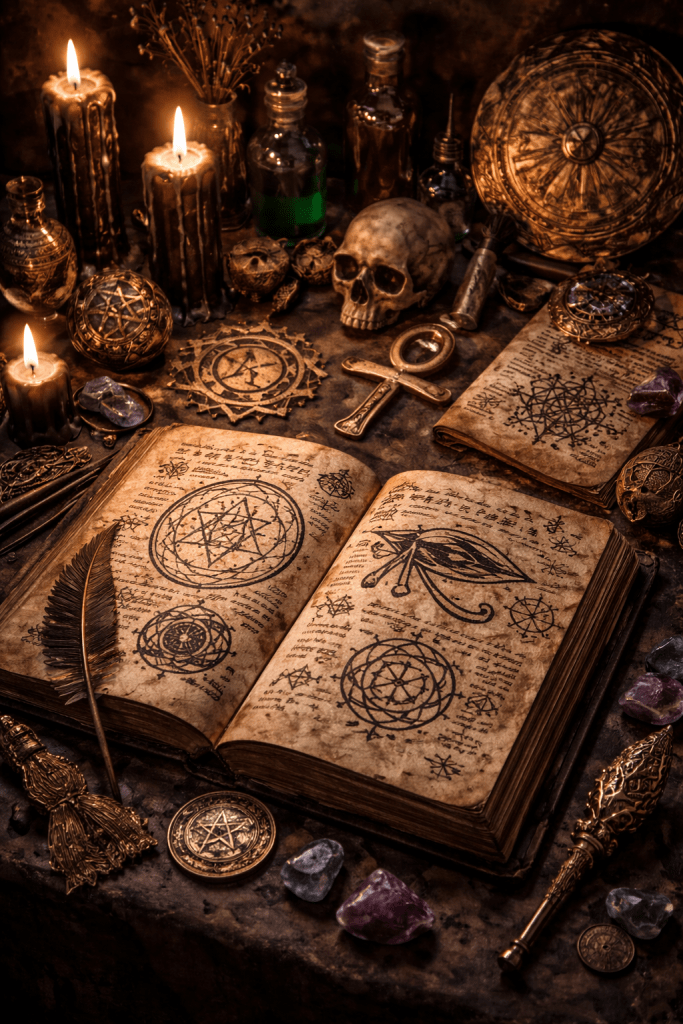
Historical Origins of Symbolic Magic
The roots of symbolic magic can be traced back to early civilizations such as Sumer, Babylon, and Assyria, where symbols were carved into clay tablets and monuments to communicate with deities, express cosmic order, or seek protection. These symbols functioned as representations of ideas rather than literal magical tools.
In ancient Egypt, hieroglyphs were deeply connected to religious belief. Egyptians believed that writing and symbols carried sacred meaning, with icons such as the Ankh symbolizing life and continuity. However, these symbols were primarily spiritual and philosophical representations rather than instruments of magic.
Symbolic Magic in Ancient Civilizations
In ancient Greece, symbols were strongly linked to philosophy and mathematics. Thinkers such as Pythagoras believed that geometric forms and numbers represented universal harmony. These symbolic systems later influenced mystical interpretations, though their original purpose was philosophical.
The Roman Empire adopted symbolic imagery extensively in religion, architecture, and politics. Symbols conveyed authority, divine protection, and imperial power, reinforcing the belief that imagery itself held influence over human perception and behavior.
During the Middle Ages in Europe, symbolic magic became associated with alchemy, astrology, and religious mysticism. Many symbolic diagrams and glyphs were misunderstood and later classified as forbidden or dangerous, contributing to myths surrounding secret knowledge and occult practices.
Myths and Legends Surrounding Symbolic Magic
Numerous myths claim that symbols can summon unseen forces, alter destiny, or grant power. Modern anthropology and psychology explain these beliefs as forms of symbolic suggestion and cognitive influence, where symbols affect emotions, decisions, and behavior through mental association rather than supernatural action.
Famous Figures Associated with Symbolic Magic
Several historical and legendary figures are often linked to symbolic magic:
Hermes Trismegistus – A legendary figure combining Greek and Egyptian traditions, associated with wisdom, writing, and symbolic knowledge. His works influenced medieval philosophy and Renaissance symbolism rather than practical magic.
John Dee (1527–1608) – An English mathematician, astronomer, and philosopher. Dee studied symbols and universal language systems in an attempt to understand divine order. Later interpretations mistakenly labeled him a magician, although his work was primarily intellectual and scientific.
These figures illustrate how symbolic study was often misinterpreted as magical practice.
Modern Scientific and Cultural Interpretation
Today, symbolic magic is understood as a cultural phenomenon rooted in semiotics, psychology, and anthropology. Symbols strongly influence human perception, branding, religion, and art. Their effectiveness lies in mental and emotional response rather than supernatural power.
Symbols remain powerful tools in modern society, used in advertising, political movements, psychology, and design. Their influence is real—but psychological, not magical.
Conclusion
Symbolic magic is not a literal form of magic, but a historical concept shaped by human imagination, belief systems, and symbolic thinking. Understanding its origins helps separate myth from reality and promotes rational, critical analysis of cultural traditions.
Reliable Sources & References
- Encyclopedia Britannica – Symbolism
https://www.britannica.com/topic/symbolism-art - Encyclopedia Britannica – Magic (Cultural Perspective)
https://www.britannica.com/topic/magic-supernatural-phenomenon - Stanford Encyclopedia of Philosophy – Symbols and Meaning
https://plato.stanford.edu/entries/symbolism/ - British Museum – Ancient Symbols and Writing
https://www.britishmuseum.org/collection
 wotopics