
(Educational and Informational Content Only)
Disclaimer:
This article is intended solely for informational and educational purposes. It does not promote, teach, encourage, or endorse any form of magical or occult practice. The content explores black magic from historical, cultural, and folkloric perspectives only.
Black magic is a term commonly used to describe beliefs and practices associated with the use of supernatural forces for harmful, malicious, or self-serving purposes. Throughout history, the concept of black magic has been shaped more by fear, mythology, religion, and social tension than by any proven supernatural reality. Modern academic studies regard black magic primarily as a cultural and psychological construct rather than an actual source of power.
Historical Origins of Black Magic Beliefs
The idea of harmful or forbidden magic can be traced back to ancient civilizations. In Mesopotamia, Babylonian and Assyrian texts mention curses and rituals believed to bring misfortune or illness. In ancient Egypt, magic was an accepted part of daily life, but practices intended to cause harm were viewed negatively and often condemned. Similarly, in ancient Greece and Rome, curse tablets and ritual inscriptions were sometimes used to symbolically express hostility or desperation, reflecting human attempts to influence fate during uncertain times.
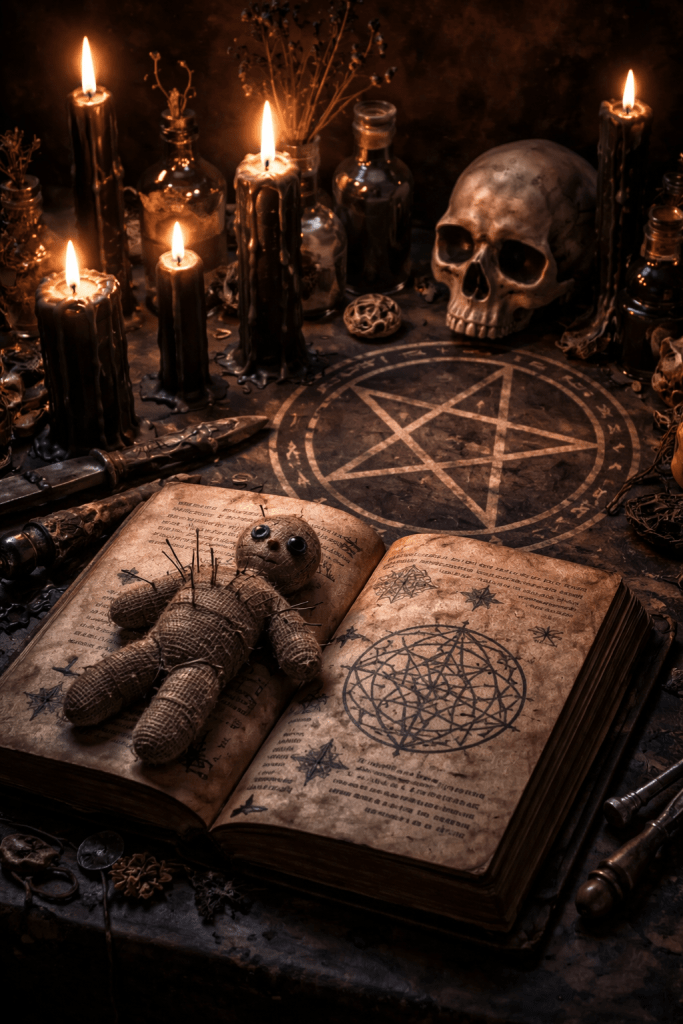
Where Black Magic Beliefs Spread Most
Beliefs surrounding black magic spread widely, but they became especially prominent in Europe between the 13th and 18th centuries. During this period, fear of witchcraft intensified due to religious doctrine, political instability, disease outbreaks, and natural disasters. Black magic was often blamed for events such as crop failure, illness, or unexplained death. This fear culminated in widespread witch trials, during which thousands of people were accused, imprisoned, or executed—often without credible evidence.
Outside Europe, similar beliefs existed in parts of Africa, the Middle East, South Asia, and Latin America, where local spiritual traditions blended with folklore and religious symbolism. Many practices labeled as “black magic” by outsiders were, in reality, traditional healing methods or symbolic rituals misunderstood through colonial or foreign perspectives.
Common Purposes Attributed to Black Magic in Folklore
Historically and within folklore, black magic was believed to be used for several purposes, including:
- Causing harm or misfortune to others
- Seeking revenge or retaliation
- Manipulating emotions or personal relationships
- Explaining illness, bad luck, or sudden tragedy
It is important to emphasize that these uses are based on belief systems rather than factual evidence. Scholars widely agree that such interpretations often arose from fear, social conflict, or psychological stress rather than real supernatural activity.
Black Magic and the Image of the Sorcerer
The figure of the sorcerer or practitioner of black magic has varied across cultures. In many societies, such individuals were portrayed as secretive, dangerous, and morally corrupt. However, historical research shows that many accused “sorcerers” were healers, astrologers, herbalists, or socially marginalized individuals.
One figure frequently associated with occult traditions in popular culture is Aleister Crowley (1875–1947). He was an English writer and ceremonial magician whose controversial writings and symbolism contributed to his reputation. While often labeled a practitioner of black magic, modern scholars generally view him as a complex intellectual figure interested in mysticism, philosophy, and symbolism rather than literal supernatural harm.
Another influential figure is Faust, a legendary character from European folklore and literature. The story of Faust, who allegedly traded his soul for knowledge and power, serves as a moral allegory warning against unchecked ambition and the pursuit of forbidden knowledge rather than a historical account of real magic.
Modern Understanding and Cultural Perspective
In contemporary scholarship, black magic is understood as a reflection of cultural fear, symbolic thinking, and psychological interpretation. Advances in science, medicine, and psychology have replaced supernatural explanations for many phenomena once attributed to magic. Today, black magic remains primarily a subject of historical study, literature, and popular culture rather than a credible force.
Understanding black magic within its cultural and historical context helps explain how societies have attempted to make sense of uncertainty, suffering, and human conflict throughout history.
References and Further Reading
- Encyclopedia Britannica – History of Magic in Western Worldviews
https://www.britannica.com/topic/magic-supernatural-phenomenon/History-of-magic-in-Western-worldviews - Wikipedia – Aleister Crowley
https://en.wikipedia.org/wiki/Aleister_Crowley - Wikipedia – Faust (legend)
https://en.wikipedia.org/wiki/Faust - University of Stirling – Academic analysis on Western occult traditions
https://www.stir.ac.uk/research
 wotopics